


Losing a tooth is more than just a gap in your smile. It changes how you chew, how you speak, and most importantly, how you feel about yourself. Whether it’s a single missing molar from an old injury or multiple missing teeth due to age or gum disease, the impact on your daily life is real.
You might be hesitating to seek treatment because you are confused about the options. Is a bridge better? What about dentures? And then there are dental implants—often hailed as the gold standard for tooth replacement. But are they just for people missing all their teeth, or can they fix a single gap?
At Orange Dental Clinic, we understand that every smile has a unique story. Navigating the world of restorative dentistry can be overwhelming, especially when terms like “single units” and “full arch restoration” start flying around.
This guide aims to clear the confusion. We will break down the differences between single tooth implants and full mouth dental implants, helping you understand which path might be the right one to restore your confidence.
What Are Dental Implants?
Before we dive into the specific types, let’s clarify what a dental implant actually is.
Think of a natural tooth. It has two main parts: the crown (the white part you see) and the root (hidden under the gum). When you lose a tooth, you lose both parts.
A dental implant is essentially an artificial tooth root. It is a small, screw-like post made of biocompatible titanium. A surgeon places this post into your jawbone, where it fuses with the bone over time in a process called osseointegration. This creates a sturdy, permanent foundation for a replacement tooth.
Unlike dentures, which sit on top of your gums, implants become a part of you. They are the only tooth replacement option that preserves your jawbone health by stimulating it just like natural roots do.
What Is a Single Tooth Implant?
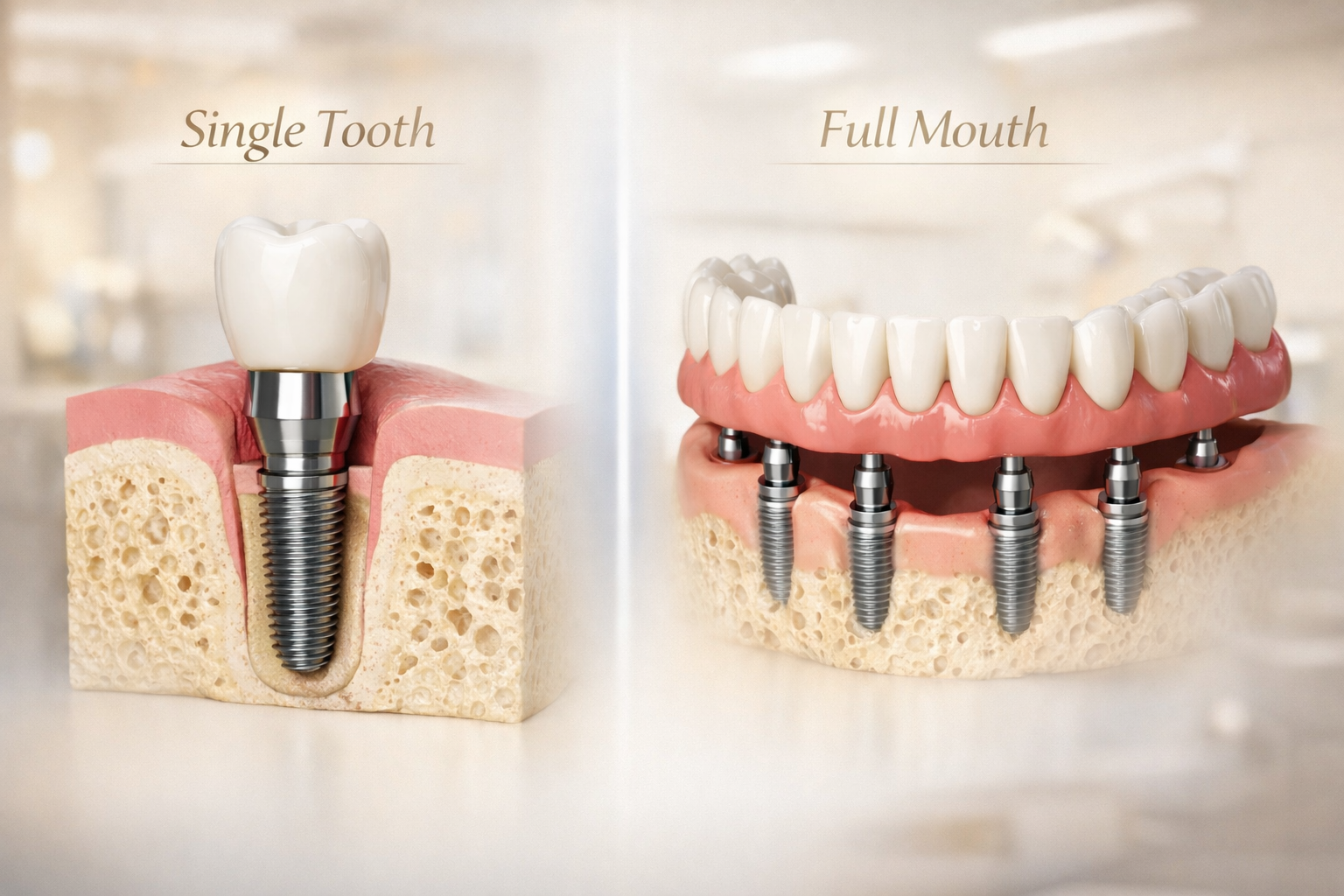
As the name suggests, a single tooth dental implant is designed to replace one missing tooth. It is the ideal solution if you have lost a tooth due to an accident, deep decay, or a failed root canal, but your surrounding teeth are still healthy.
How It Works
The process is straightforward. We place one implant post into the gap. Once it heals, we attach a custom-made crown on top. This crown is crafted to match the shade, shape, and size of your natural teeth perfectly.
Why Choose This Option?
- Preserves Natural Teeth: Unlike a traditional dental bridge, which requires grinding down healthy adjacent teeth to support the false tooth, an implant stands alone. Your other teeth remain untouched.
- Natural Look and Feel: It feels exactly like your own tooth. You can brush and floss around it just like normal.
- Long-Lasting: With proper care, a single implant can last a lifetime.
If you have a gap in your smile that makes you self-conscious, a dental implant specialist near me can help you determine if this is the right fix.
What Are Full Mouth Dental Implants?
If you are missing most or all of your teeth on one or both arches (upper or lower jaw), replacing them one by one with individual implants would be impractical and expensive. This is where full mouth dental implants come in.
This treatment doesn’t mean you get 32 separate screws in your jaw. Instead, we use a strategic number of implants (usually 4 to 6 per jaw) to support a full arch of replacement teeth.
Types of Full Mouth Options
- Implant-Supported Dentures: These are removable dentures that “snap” onto implants for stability. No more messy adhesives or slipping while talking.
- Fixed Full-Arch Bridges (All-on-4): These are permanent sets of teeth screwed onto the implants. Only a dentist can remove them. They function and look just like a natural set of teeth.
Why Choose This Option?
- Total Restoration: It restores 90-95% of your chewing power, allowing you to eat apples, nuts, and steak again.
- Bone Preservation: It prevents the “sunken face” look that often happens with long-term denture wearers due to bone loss.
- Confidence Boost: You never have to worry about your teeth falling out in public.
Single Tooth vs. Full Mouth Implants: Key Differences
Choosing between these treatments depends largely on your specific condition. Here is a quick comparison to help you understand the landscape.
1. The Scope of the Problem
- Single Implant: Best for localized issues. If you have one or two missing teeth with healthy teeth in between, this is your path.
- Full Mouth: Best for widespread issues. If your remaining teeth are failing due to severe gum disease or decay, clearing the infection and starting fresh with a full arch might be healthier.
2. The Procedure Complexity
- Single Implant: Less invasive. Recovery is quicker, often with just local anesthesia.
- Full Mouth: More complex. It may involve extracting remaining teeth and leveling the jawbone. Sedation is often used to ensure comfort.
3. Cost Considerations
- Single Implant: Lower total cost, but higher “per tooth” cost if you try to replace many teeth individually.
- Full Mouth: Higher upfront investment, but significantly more cost-effective per tooth when replacing a whole arch.
4. Recovery Time
- Single Implant: You can often return to work the next day.
- Full Mouth: Expect a few days of rest. You may need a soft diet for a few weeks while the implants heal and fuse with the bone.
Cost Considerations in Chandigarh
We know that cost is a major factor for our patients. When looking for dental implants in Chandigarh, you will find varying prices.
The cost depends on several factors:
- The brand of the implant used.
- The need for additional procedures like bone grafting or sinus lifts.
- The type of final restoration (crown vs. full bridge).
While permanent tooth replacement requires a financial investment, it is important to view it in the long term. Traditional bridges or dentures often need replacement every 5 to 10 years. Implants are designed to last decades.
Choosing a cheap, quick fix often leads to higher costs down the road due to repairs and replacements. At Orange Dental Clinic, we provide transparent pricing and flexible payment plans so you can prioritize your health without stress.
Which Option Is Right for You?
So, how do you decide?
Choose a Single Tooth Implant if:
- You are missing only one or two teeth.
- Your jawbone in that area is healthy.
- Your surrounding teeth are in good condition.
Choose Full Mouth Implants if:
- You are currently wearing dentures and hate them.
- You have multiple missing teeth and the remaining ones are loose or decayed.
- You want a permanent, hassle-free solution for your whole smile.
Ultimately, Google can only tell you so much. The only way to know for sure is to get a professional assessment. Every mouth is different, and bone density plays a huge role in eligibility.
Take the First Step Toward a Complete Smile
Living with missing teeth affects your confidence and your health. But you don’t have to settle for gaps or uncomfortable dentures. Whether you need to replace a single tooth or rebuild your entire smile, modern dentistry has a solution for you.
Don’t let fear or confusion hold you back. Get a personalized implant treatment plan that addresses your specific needs.
Book a dental implant consultation with our experts today.
Meet our implant specialist to discuss your concerns.
Explore our dental implant treatments to learn more about the technology we use.
Restore your smile with confidence.
Book your dental implant consultation today!

