


Author: Orange Dental Clinic Team — reviewed by Dr. Ankita Dadwal (MDS, Periodontist & Implantologist) & Dr. Sahiba Dadwal (MDS, Endodontist & Cosmetic Dentist)
A root canal is meant to be a permanent solution — the infected pulp is removed, the canal is cleaned and sealed, and the tooth is protected with a filling or crown. Most of the time, that’s exactly how it plays out. But occasionally, a previously treated tooth starts causing pain again months or even years later. When that happens, the question isn’t whether something is wrong — it’s whether the tooth can be saved with retreatment, or whether extraction has become the only option.
Why a Root Canal Can Fail
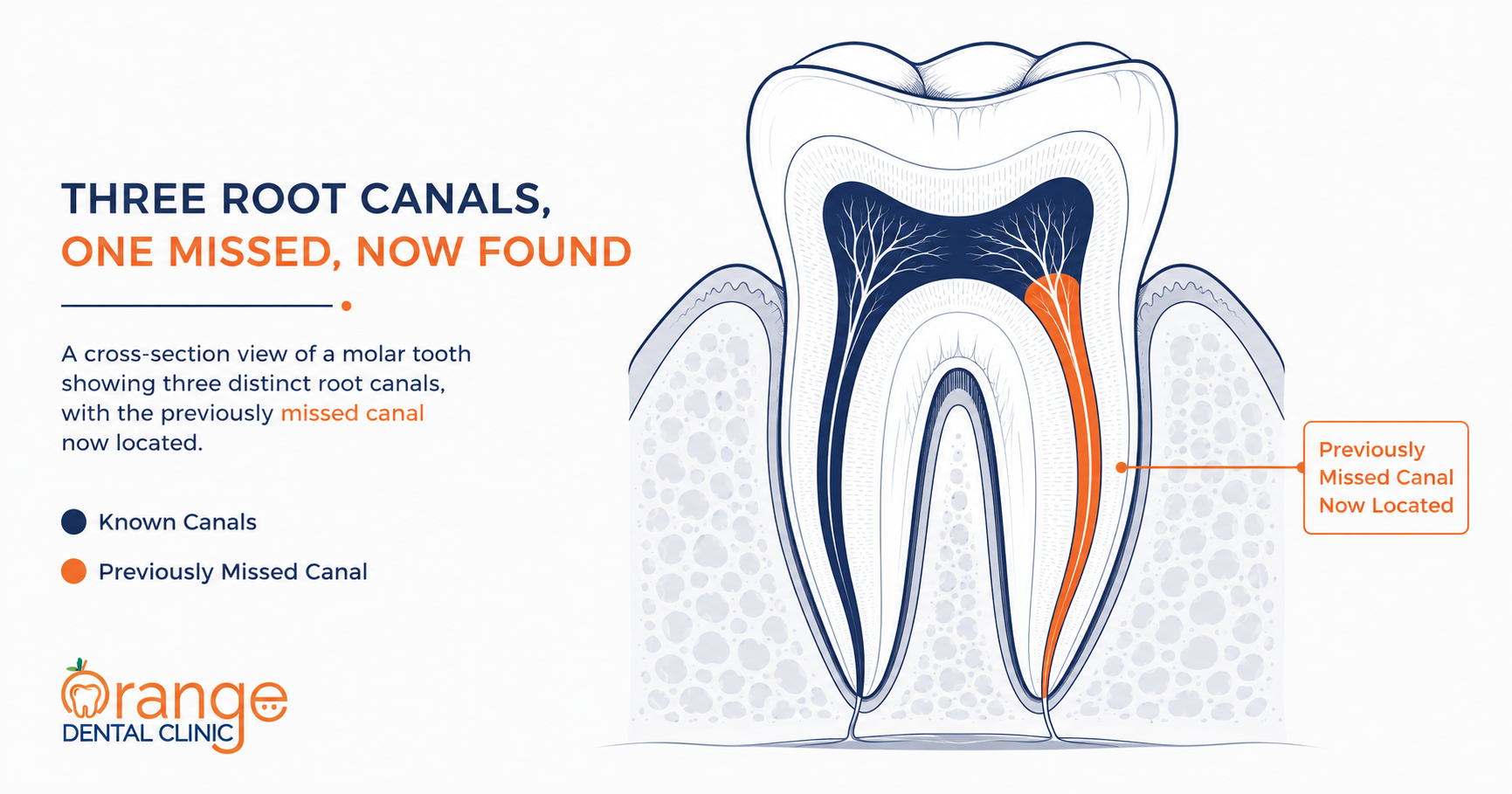
- Missed or unusually shaped canals — some teeth, particularly molars, have complex canal anatomy that can hide an extra canal during the original treatment
- New decay reaching the pulp chamber through a crack in the filling or crown seal
- A crown or filling placed too long after the root canal, allowing bacteria to re-enter in the meantime
- A vertical crack in the root that develops after treatment, creating a new pathway for infection
- Reinfection due to a breakdown in the seal over time
None of these necessarily reflect a problem with how the original procedure was done — some are simply the nature of treating anatomically complex teeth, and some happen years after treatment for reasons unrelated to the original work.
Signs a Previously Treated Tooth May Need Retreatment
- Pain or sensitivity returning in a tooth that had a root canal, especially with chewing pressure
- Swelling or a small pimple-like bump on the gum near the treated tooth
- Persistent tenderness that doesn’t resolve on its own
- Discolouration of the tooth that develops after treatment
- A new area of decay or a cracked filling visible around the treated tooth
It’s worth noting that a treated tooth can also fail silently — without pain — which is why a follow-up X-ray, even for a tooth that feels fine, is sometimes recommended if it’s been several years since the original treatment.
Diagnosing the Problem
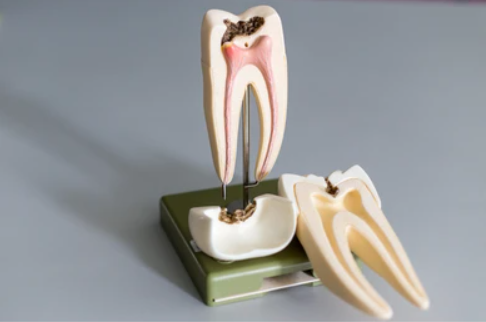
Dr. Sahiba Dadwal typically starts with an X-ray to check for shadowing at the root tip, which can indicate ongoing infection, along with a clinical exam to check the crown or filling seal and test for any cracks. In some cases, the original canal filling material needs to be carefully removed to inspect the internal anatomy for a missed canal — something that isn’t always visible on a standard X-ray.
What Retreatment Involves
Root canal retreatment follows a similar process to the original procedure, but starts by removing the existing filling material from the canal before re-cleaning, disinfecting, and resealing it. Where a missed canal is the cause, that canal is located and treated during the same visit. Once retreatment is complete, the tooth generally needs a new crown or restoration if the seal or existing restoration was compromised.
Retreatment vs. Extraction and Implant
Retreatment is usually the first option considered, since keeping a natural tooth is almost always preferable when it’s structurally viable. However, if the root has a vertical crack, if there isn’t enough healthy tooth structure remaining to support a restoration, or if the surrounding bone has been significantly compromised, extraction followed by a dental implant may be the more realistic long-term option. This decision is made case by case, in consultation with both the endodontic and implant teams at ODC, rather than defaulting to either path automatically.
| Pain in a Previously Treated Tooth? If a tooth that’s had a root canal is bothering you again, don’t wait for it to get worse. Dr. Sahiba Dadwal can assess whether retreatment is possible or discuss alternatives, based on an X-ray and clinical exam. 📞 Call Orange Dental Clinic | 🌐 orangedentalclinics.com | 📍 SCO 2441-42, Sector 22C, Chandigarh |
The Bottom Line
A root canal failing isn’t the end of the road for a tooth — in most cases, retreatment gives it a genuine second chance. The key is not ignoring the signs: pain, swelling, or tenderness in a previously treated tooth are worth investigating early, while retreatment is still the simplest option on the table.
